
Lafayette Current Owner Card
Every Lafayette County current owner card starts with a name field pulled from two streams. Tri-State labels it owner or ownername. The ArcGIS layer calls it OWNNAME. Either way, the owner of record only means something next to its parcel number, situs address, mailing address, legal description, deed reference, tax year, and the date you viewed the record.
That surrounding detail keeps a bare name from reading like a certified title result. It also flags a wrong parcel fast when an address search in the property records returns several rows at once.
| Displayed owner | OWNNAME or ownername as carried in the parcel roll |
|---|---|
| PPIN / PARID | The keys that distinguish this tract from similar addresses |
| Mailing address | Where assessment or tax correspondence is directed |
| Situs address | The physical property location, when populated |
| Legal description | Lot, subdivision, or sectional land text used for matching |
| Deed reference | The book/page clue for the recorded ownership instrument |
Expect some oddities in Lafayette County results. A mailing address can sit outside the county, and a rural parcel sometimes shows a situs value of zero. Neither quirk cancels the parcel; trust the GIS map and the legal description before drawing any conclusion from the tax roll.
Current Does Not Mean Instant
Current does not mean instant in Lafayette County. The county describes its assessment data as uploaded frequently, yet still possibly lagging courthouse activity. No owner-update turnaround in days is published. The assessor appraises from a January 1 context. Tri-State's current shell shows an effective year of 2026. Those are date signals only. They never warrant that each owner of record changed on one shared schedule.
A deed filed after the tax roll snapshot can name a different grantee. Probate, foreclosure, quiet-title, and tax-deed events may also shift legal rights. The deed records display can lag behind them. Note the date you saw a result and check for later instruments.
Owner timing. Treat the assessment name as a dated display and the latest valid recorded deed as the stronger current-owner evidence.
View Lafayette's Current Roll
The Tri-State county shell lists the active Lafayette County assessment and tax links with the effective year.
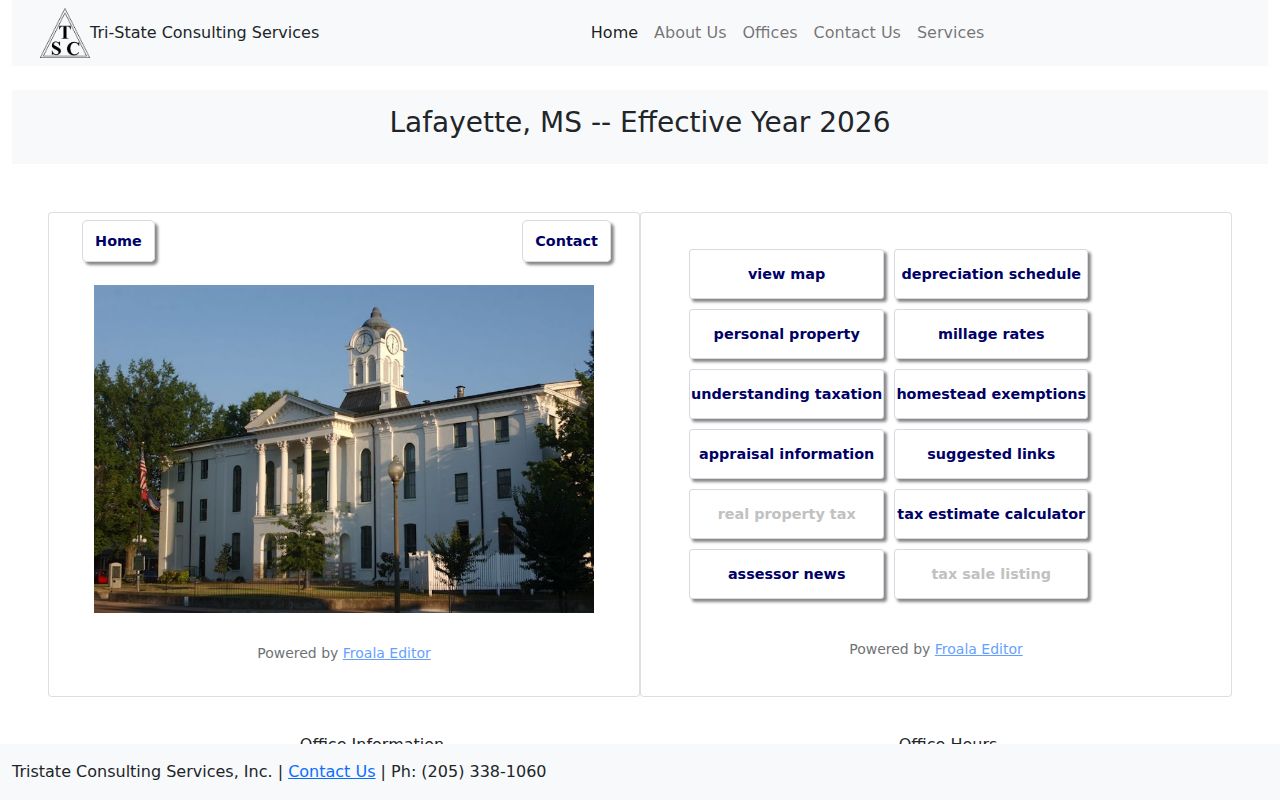
The portal screen tells you when the roll was last updated, which matters for any current owner check. The parcel row and the deed carry the real proof for that property.
Confirm Lafayette's Owner of Record
Start with the Tri-State assessment search, but the name column alone settles nothing. Whether the name is truly the current owner depends on the parcel identity and the latest deed agreeing. Search by full address first, then switch to PPIN or PARID if the portal accepts them.
- Save the exact owner spelling, PPIN, PARID, situs, and legal description from the assessment result.
- Compare the parcel polygon and
OWNNAMEin the GIS layer. - Use the deed book/page or owner name in the Delta Chancery index and select the newest matching conveyance.
- Check for a later probate, foreclosure, judgment, or tax deed when the two names differ.
- Owner of record
- The party named in a dated official ownership stream.
- Vesting
- The manner in which the deed states an interest is held.
- Registered agent
- A formal contact for an entity, not proof of personal parcel ownership.
Entity Owners in Lafayette Records
The owner of record line in Lafayette County property records is not always one person. It may list an LLC, a trust, several co-owners, or someone holding a life estate. Copy the line exactly. Search that exact wording in the deed index. Then retry with a core entity name or surname when punctuation hides the match.
The Mississippi Secretary of State Business Search can confirm a business ID and its registered agent. That helps when a deed names an LLC as grantee. It cannot show that the agent owns the land. It cannot reveal every beneficial interest, and it never replaces the recorded instrument. Trust questions often turn on the deed itself. The answer usually sits in related legal documents rather than a public business entry.
Owner Changes Beyond a Simple Deed
Ownership after a death may move through probate. A later executor, heir, or distribution deed can carry the transfer. A death certificate does not convey land. Lafayette Chancery Court handles wills, probate, guardianships, and title disputes. Court filings moved to MEC on June 19, 2023, while land instruments stayed in Delta.
Foreclosures and tax sales need equal care. A sale listing or tax-sale bidder is not automatically the current owner with clear title. Redemption periods and judgments can affect title. Foreclosure deeds, tax deeds, and later land records can affect it too. Cross-check the parcel's legal description at every stage.
Mississippi vital records can support a relationship or a date. But a death or marriage certificate is not a deed. The Chancery probate file provides the property trail. An executor, heir, or distribution instrument continues it.
A court docket is a lead, not a transfer. Record the case number, parties, filing date, status, and document date. Then locate the matching land instrument. Public MEC access may face case restrictions.
Contact a Lafayette Property Owner
Need to reach the owner of record on a Lafayette County parcel? The assessment mailing address is your best lead. Send a letter about the parcel, include a return address, and do not assume the recipient lives at the situs. The owner of record may be an entity. In that case, the Secretary of State registered-agent entry opens a more formal business contact route.
Some Lafayette County property records show a protected or redacted address. Mississippi's Address Confidentiality Program gives qualifying participants a substitute mailing address. That shield should be respected. Note: Never cross-check databases to uncover a confidential location.
Lawful use. Contact information may support a genuine property inquiry. Never use current owner data to stalk, harass, threaten, or evade a protected address.
Title questions deserve more than a quick lookup. The owner-finding route settles the parcel first. Still, it is a research step, not a title opinion. For real certainty, turn to the Lafayette County Chancery Clerk or a qualified title professional. The clerk's office sits at 300 N Lamar Boulevard in Oxford. It opens weekdays from 8 a.m. to 5 p.m. Bring the PPIN, PARID, deed book and page, exact party names, and the legal description. If an image is not free online, ask the counter about the copy or certification cost. That cost differs from the deed-filing fee.
Older Lafayette County records take patience. The Delta Virtual Index Books let you browse DEED and DOT volumes by book and page. No earliest online year is stated. MDAH and University of Mississippi finding aids can point to historic land or assessment volumes. Those sources extend the trail back through time. They cannot make an undated assessment owner current.
Keep the whole record card, not just a name. Save the PPIN, PARID, owner spelling, situs address, mailing address, legal description, deed book and page, and tax year. Also save the portal URL and inspection date. Watch for name mismatches too. If ArcGIS OWNNAME and the Tri-State ownername differ, confirm both rows describe the same polygon and land text. Do that before assuming a timing problem. A deed reference in the assessment result may look incomplete or oddly formatted. In Delta, search by grantor, grantee, filing date, instrument number, subdivision, or section-township-range. Select deed as the instrument type. A mortgage, deed of trust, release, or assignment matters to title work. None of them, on its own, names a new current owner.
Lafayette County publishes no fraud-alert signup. Report a suspicious owner change straight to the Chancery Clerk with the parcel and instrument details. Keep screenshots and dates. Avoid contacting unrelated people who share a surname. Get qualified help whenever a filing's legal effect is unclear.