
Chart Lafayette's Prior Owners
Start your Lafayette County past-owner chart with a simple worksheet. One row should stand for a single verified transfer of the same land. Record the deed date and the filing date separately, since they often differ. Keep the full legal description next to the parties' names. Watch for jumps between lots or acreage calls.
Those jumps matter.
A shift from one lot to another may mark a split. A move from an acreage call to a block number can signal a combination. It may even point to an entirely different parcel.
| Transfer date | Grantor → grantee | Instrument | Recorded reference |
|---|---|---|---|
| Newest verified date | Prior owner → displayed owner | Conveyance type | Instrument or book/page |
| Earlier verified date | Earlier owner → prior owner | Conveyance type | Instrument or book/page |
| Next proven date | Older owner → earlier owner | Conveyance type | Instrument or book/page |
Treat these labels as a model rather than real owners. Add acreage, lot and block, subdivision, source URL, and any doubts of your own. Stop when a page cannot be checked. That habit beats guessing with a tax-roll name.
Assessment rolls still help bracket a period. The University and state finding aids hold land and real-estate assessment material. Modern Tri-State results pair deed references with owner and legal fields. Treat each roll name as a lead for the deed search. A taxpayer might hold a life estate, an inherited share, or a partial assessed interest. That interest never maps to one clean conveyance.
Read Lafayette's Chain Backward
The Delta grantor-grantee index runs on direction. The buyer shows up as grantee on the acquiring deed. The seller shows up as grantor.
To walk the chain backward, take that grantor and search for the same person as grantee on an earlier deed, confirming the land at every link.
- Find the latest supported conveyance using the displayed owner, deed reference, PPIN, PARID, or legal description.
- Copy the grantor, grantee, instrument type, filing date, and complete land description.
- Search the grantor as a grantee in an earlier range. Compare acreage, lot, block, phase, and section calls.
- Repeat until an index or image ends. Carry the exact reference to the Chancery Clerk or an archive.
- Grantor
- The party conveying the stated interest.
- Grantee
- The party receiving that interest.
- Chain of title
- The supported sequence of conveyances for one tract.
- Reverse index
- A receiving-party path used to locate an earlier acquisition.
- Quitclaim and warranty deed
- Different conveyance forms whose title promises are not the same.
Lafayette Searches Beyond Names
The Delta Deeds and Records index accepts grantor or grantee, book and page, filing date, instrument number, section-township-range, subdivision, and block. Lot is accepted too. Use a partial name only to surface candidates. Then narrow each hit by legal description and date. Rural Lafayette results sometimes show an assessment address of 0. When that happens, section calls and parcel identifiers do the real work.
Do not confuse a deed with a mortgage or deed of trust. Assignment, release, lis pendens, and foreclosure records are separate too.
A lender on a security instrument never became an owner by signing it. Chase the later satisfaction or release, plus any deed, as separate records.
Pause whenever the legal description changes. A smaller acreage or a new lot number can signal a split. A later subdivision phase can signal a replat. Follow the old and new plat references. Then note which part carried forward. That step matters. It keeps a parent-tract chain from masquerading as the full history of a later lot.
The county-linked deed form displays the routes used to reconstruct former ownership.
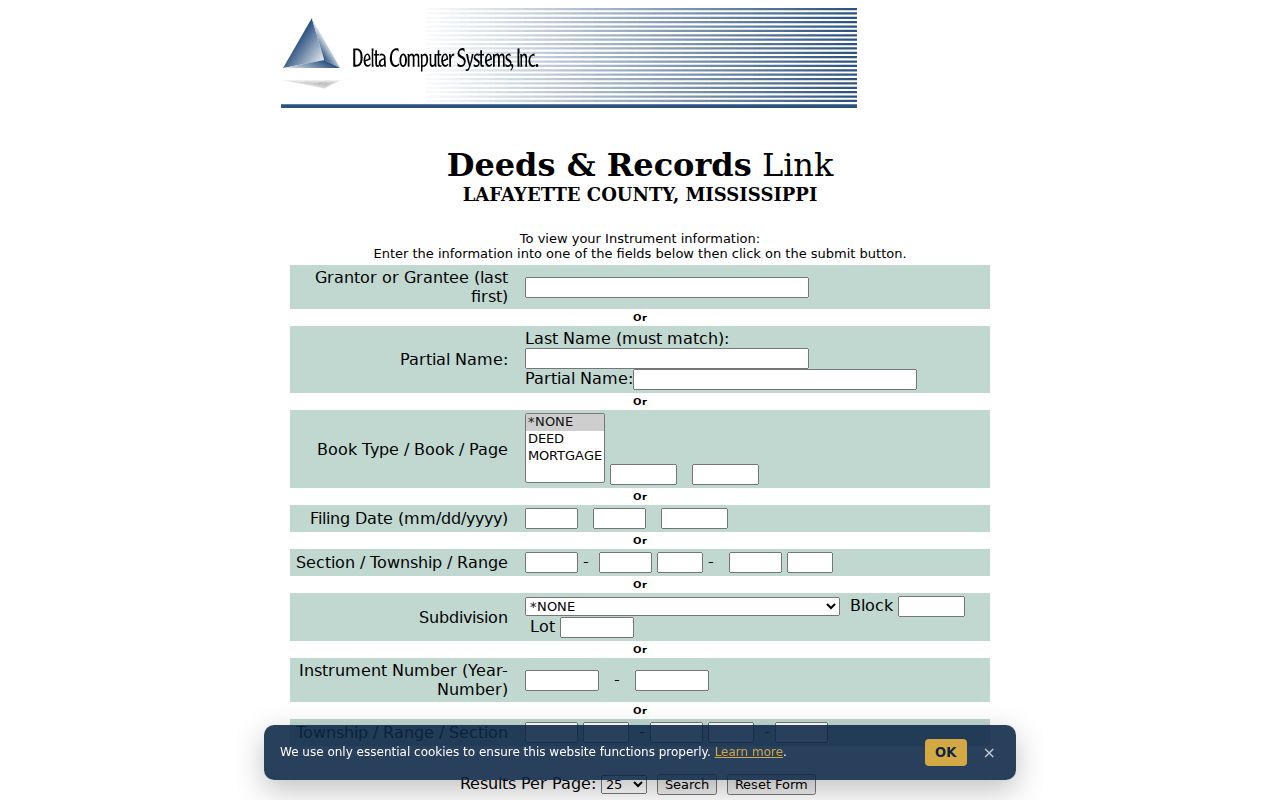
The capture shows why legal-description and document controls belong beside a party name.
Probate May Bridge Lafayette Owners
An unbroken deed chain sometimes stops cold. A Lafayette County parcel may pass through an estate. Wills, probate, guardianships, and title questions belong to Lafayette Chancery Court. Its filings moved to the MEC system on June 19, 2023. Land records, though, stayed on Delta. That split matters. A former-owner search may need both. The court file shows who had authority and how property was distributed. A later executor, heir, or distribution deed ties that event back to the parcel.
Never treat a will, death certificate, or docket entry as a conveyance on its own. Match the decedent, the representative, the legal description, and the final recorded instrument. Restricted vital-record rules sit apart from deed access.
Lafayette's Online Depth Varies
Lafayette County's online deed index publishes no earliest calendar year. A starting date takes digging. The Virtual Index Books let you browse DEED and DOT books. A book number is not a year, though. Confirm the page and index entry before trusting any date. If an image is missing, ask the Chancery Clerk to pull the cited book. The Clerk can also advise on older media. The virtual books shine at tracking a reference you already hold.
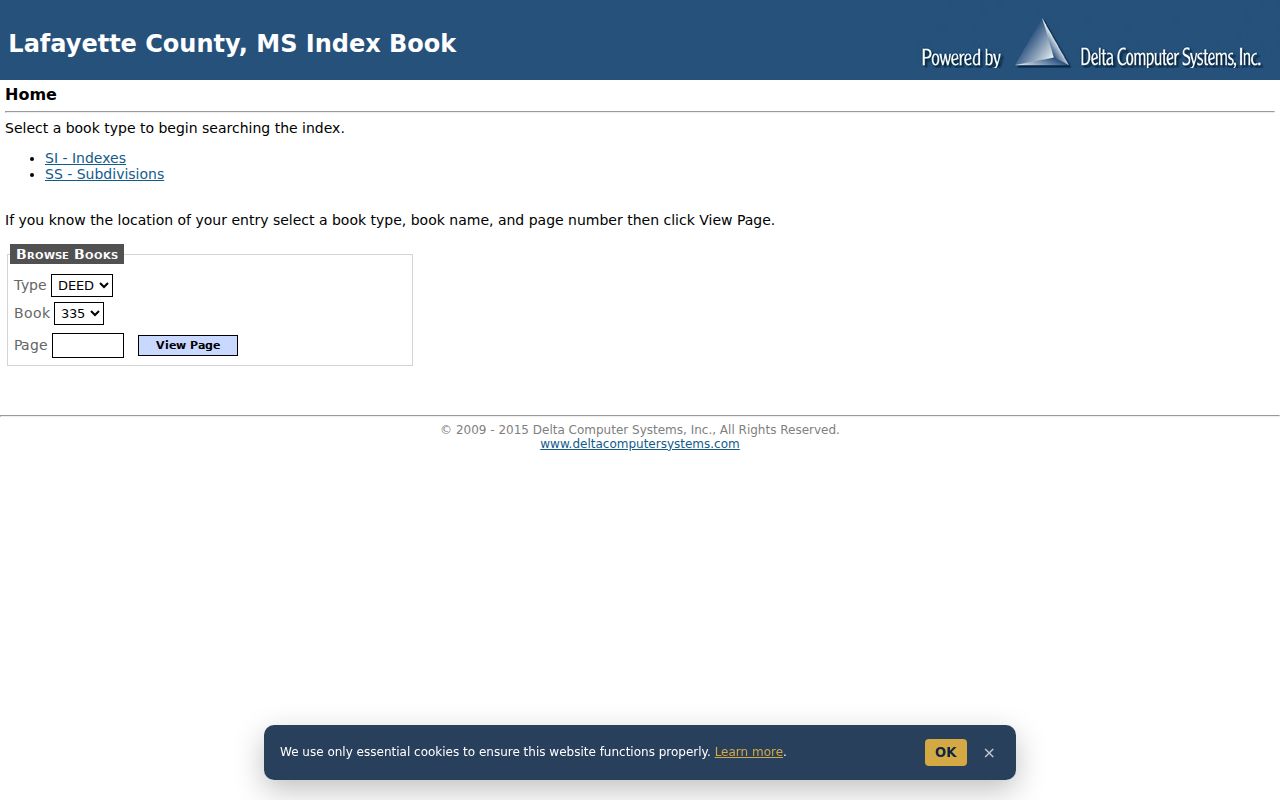
The browser confirms the book/type route while leaving the earliest online year unresolved.
Do not invent a cutoff. Online depth varies by book; older prior owners may require courthouse volumes and archive finding aids.
Archive Trails for Lafayette Owners
Older Lafayette County owners leave traces beyond the recorder. The MDAH county inventory lists Chancery abstract books from October 1872 through July 1890. It also covers 16th Section abstracts from April 1891 through February 1912, and a Chancery item dated April 1839. A University of Mississippi finding aid covers 135 volumes plus one box of Lafayette County Records spanning 1880 to 1951, with land rolls and real-estate assessments. FamilySearch catalogs deed records from 1830 to 1889. It also holds a deed index from 1836 to 1894. Mississippi State holds an 1845 tax-roll index and an 1874 taxpayer list. These sources can point toward prior owners. Assessment names are still only clues until tied to land instruments. The state finding aid lays out how the historic record groups are organized.
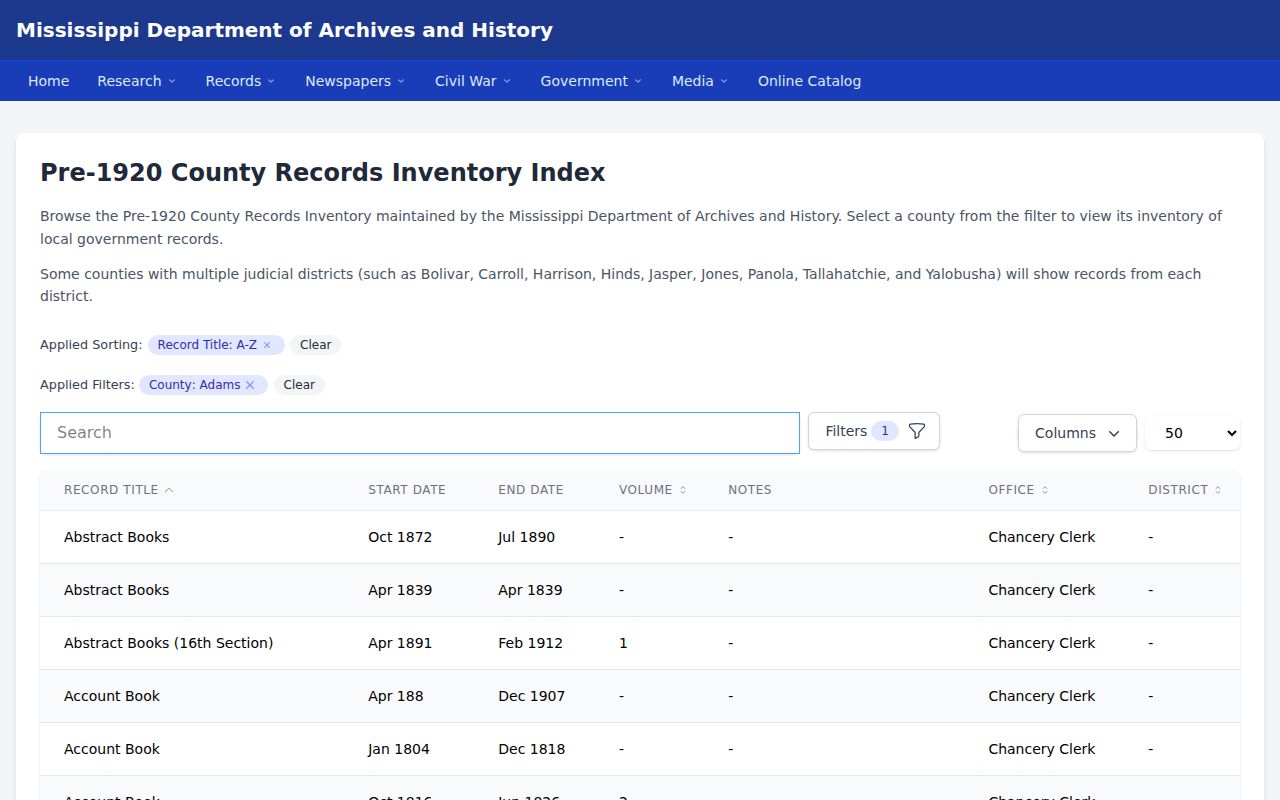
The inventory supplies collection dates for the next request, not a modern title result.
Why Lafayette Volumes Survived
Lafayette County almost lost its early records. The county's own history account describes a Civil War raid that burned the square. A 14-year-old Oxford resident reportedly rescued most of the county records from the flames. The papers then traveled by wagon. They stayed scattered around the county for nearly ten years. Not until the 1871 courthouse went up did they come home. That ordeal explains the disorder. Historic property records do not sit on one continuous shelf in tidy order.
Gaps remain, so ask about what survived. Abstracts, copied indexes, and reconstructed volumes can help. They can bridge a broken chain in Lafayette County deed records. Rescue stories rarely mean every page made it. Each ownership link still rests on a record that can be found and matched.
The local Genealogy Room adds depth. It holds family files, obituaries, cemetery work, marriage-related records, and an enslaved-person probate index. Those materials can explain a surname change or an estate relationship. They cannot replace the recorded land source, though. Cite them as context. Then return to the deed, probate order, or distribution instrument for the ownership link.
Old Lafayette Names Find Owners
Old geography can free a stalled Lafayette County property search. Taylor's official history traces one community through several names. It began as Yocona Station, became Taylor's Depot, then Taylor. Incorporation came in 1873. A renaming followed in 1907. Charter revocation came in 1972. Restoration with boundary expansion came in 1973. An old deed may therefore name a rail stop rather than a modern street address.
Oxford subdivision names offer similar clues. Acadia Court, Briarwood, Cross Creek, Franklin Farms, Grand Oaks, and Highlands all appear in local plats. Search the exact phase with its lot, block, plat, and deed reference. Remember that neither a historic name nor a current postal city proves jurisdiction.
Note: Place names only suggest candidates; the legal description confirms whether two deeds concern the same Lafayette County land.
Close Lafayette Ownership Gaps
Careful notes hold a chain together. For every transfer, record the source URL, inspection date, instrument type, parties, reference, legal description, acreage, and any unresolved doubt. A plat change means noting both lot descriptions. If probate explains possession but no deed surfaces, leave that fact open.
Dates deserve their own care. Keep the execution date, the filing date, and the date you inspected the source as three separate facts.
For a single known instrument, the Lafayette County deed records resource covers index fields and copy channels. A historical chain works differently. It moves back one proven transfer at a time. It never labels a lender, taxpayer, executor, or tax-sale bidder as owner of record without the document that supports that status.
Use ownership history lawfully. Research may support title work, house history, and purchase diligence; never use it to target or harass a person.